
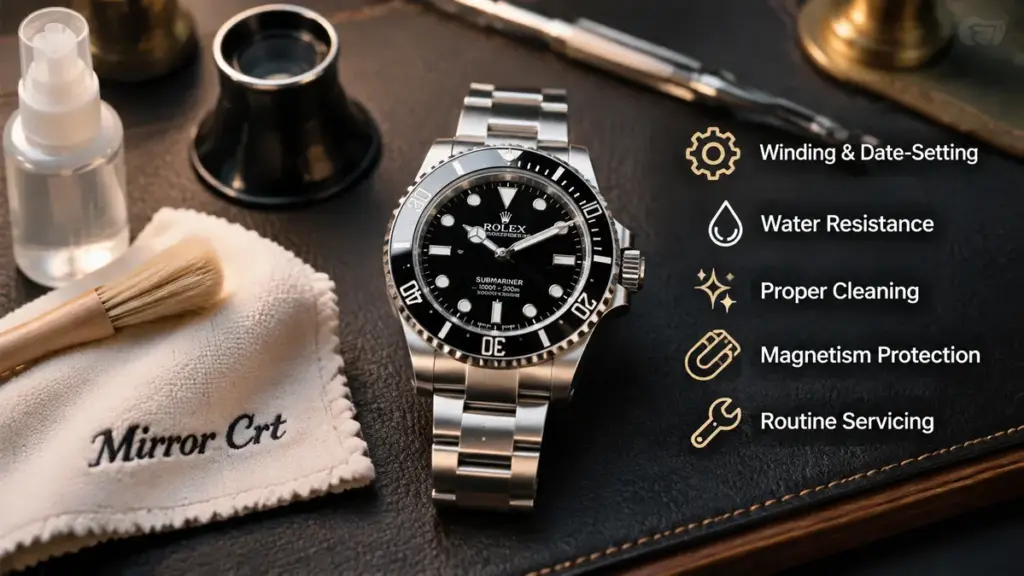
A well-built 1:1 Swiss super clone watch contains over 200 microscopic gears, pivots, jewels, and balance springs operating at 28,800 vibrations per hour. Treated with the same mechanical respect as any fine Swiss timepiece, a high-grade super clone from Mirror Crt will deliver accurate timekeeping and crisp exterior finishing for 5 to 10+ years.
Conversely, simple preventable mistakes-like changing the date at midnight or submerging a watch with an unscrewed crown-cause the vast majority of movement repairs. Follow this watchmaker-approved maintenance guide to protect your investment across every piece in your collection.
1. Master the Safe Winding & Date-Setting Ritual
- Manual Startup Winding: When picking up an automatic watch that has stopped, unscrew the crown to Position 1 and turn it clockwise 25 to 30 full turns before setting the time. Giving the mainspring a healthy baseline charge ensures stable amplitude and prevents the watch from stalling mid-day.
- Respect the Date-Change “Danger Zone” (9:00 PM – 3:00 AM): On calendar watches like the Rolex Datejust, Day-Date, and Patek Philippe Nautilus, the date-advance gears begin engaging the date wheel around 9:00 PM and do not fully disengage until 3:00 AM. Never use the quick-set date function while the hands are between 9:00 PM and 3:00 AM, as forcing the wheel can strip delicate calendar teeth. Always advance the hands to 6:30 first, set the date to yesterday, and then advance the hands forward past midnight.
- Chronograph Pusher Discipline: On mechanical chronographs like the Rolex Daytona (Caliber 4131) or Omega Speedmaster (Caliber 3861), always press the top Start/Stop pusher to halt the timer before pressing the bottom Reset pusher. Pressing reset while the chronograph is running puts severe shock on the heart-cam lever.
2. Water Resistance & Crown Safety Rules
Even though dive models like the Rolex Submariner, Yacht-Master, and Omega Seamaster are built with screw-down crowns and rubber O-ring caseback gaskets, water safety depends on three habits:
- Verify the Crown is Finger-Tight: Always press the crown inward and turn clockwise until snug (never over-torque with pliers) before exposing your watch to water.
- Avoid Hot Showers, Saunas & Steam Rooms: Extreme heat causes metal cases and rubber gaskets to expand at different rates, allowing microscopic steam vapor inside the crystal-even on watches rated for swimming.
- Get an Annual Pressure Test: Rubber O-rings dry out over 12–18 months. If you plan to swim with your watch, have a local watchmaker perform a 5-minute dry pressure check and lubricate the caseback gasket with silicone grease once a year.
3. Safe Weekly Cleaning for Steel, Gold & Carbon Cases
Body oils, sunscreen, and dust accumulate between bracelet links and act like fine sandpaper, accelerating bracelet stretch over time.
- For Stainless Steel Models (AP Royal Oak, Rolex GMT-Master II): Ensure the crown is screwed down tightly. Rinse under lukewarm tap water, apply one drop of mild pH-neutral dish soap, gently brush between links with an extra-soft baby toothbrush, rinse thoroughly, and pat dry with a lint-free microfiber cloth from our Watch Accessories collection.
- For 18kt Gold-Wrapped & Rose Gold Models (Rolex Land-Dweller, Patek Philippe Aquanaut): Never use abrasive jewelry polishing cloths (like Cape Cod wipes) on brushed surfaces or gold-wrapped finishes, as polishing compounds strip away factory satin brushing and thin precious metal layers. Use only mild soap, water, and soft microfiber.
- For Carbon TPT Cases (Richard Mille, Hublot Big Bang): Wipe down with a damp microfiber cloth-never submerge Carbon TPT cases in harsh chemical solvents.
4. Magnetism Protection & Routine Servicing
- Keep Away from Strong Magnets: Laptop magnetic clasps, MagSafe phone chargers, and speaker drivers can magnetize a steel hairspring in seconds. If your watch suddenly begins gaining 1–5 minutes per day, a $15 tabletop demagnetizer restores normal accuracy immediately.
- Recommended Service Interval: Every 4 to 5 years, have a trusted independent watchmaker perform a basic movement clean, lubrication, and regulation so fresh synthetic oils keep pivot friction near zero.
For coverage details on movement reliability and quality checks, review our Warranty Policy, Returns & Exchange, and Order Guide.
Frequently Asked Questions: Maintaining Your Super Clone Watch
Can I put my super clone watch in an ultrasonic cleaner?
Never put an assembled watch head inside an ultrasonic cleaner. Ultrasonic vibrations can shake microscopic balance jewels loose and force water past gaskets. You may detach a solid steel bracelet and clean only the bracelet ultrasonically, while cleaning the watch head gently by hand.
How often should I wind my automatic watch if I don’t wear it every day?
If your watch is stored in a box rather than an automatic winder, winding it 20–25 turns once every two weeks keeps the internal lubricants distributed across the gear train so oils do not thicken or pool.
What should I do if fog or condensation ever appears under the crystal?
Immediately pull the crown out to stop the movement, place the watch face-down on a warm (not hot) towel or inside a sealed container with silica gel packets, and bring it to a watchmaker promptly so moisture does not oxidize the steel hands or balance spring.
Why does my watch run 5–8 seconds fast or slow per day? Is that normal?
Yes. Any mechanical watch running within -10 to +10 seconds per day is performing well within healthy horological tolerances. Temperature, wrist activity level, and resting position overnight all slightly influence daily mechanical rate.
How do I prevent desk-diving scratches on polished center links and clasps?
Rest your wrist on a soft leather desk pad while typing, keep your clasp closed when laying the watch down on hard surfaces, or apply precision pre-cut transparent protective film kits available for popular Rolex and Patek Philippe references.